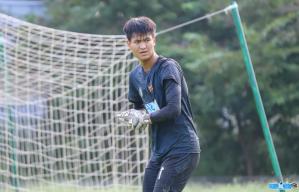
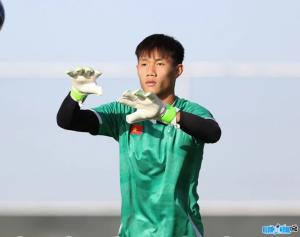
Football player Dinh Quang Kiet
Dinh Quang Kiet
Living place: Gia Lai
Birthday: 16-7-2007 (19 years old)
Population of Vietnam 2007: 84,22 millions
Global rank: #94790
Facebook: facebook.com/inhquangkiet
Email: updating
Phone number: updating
Dinh Quang Kiet is known as one of the most prominent young players in football Vietnam today. With a height of nearly 2m, he became a rare center -back with outstanding advantage in the ball dispute, helping HAGL to have more certainty in the defense.
Road to football and journey at HAGL
From an early age, Quang Kiet revealed his passion for football. Thanks to his superior body compared to his peers, he quickly caught the "blue eye" of the scouts. After that, he was selected to HAGL training furnace-one of the leading football institutes in Vietnam, where the stars were forged like Cong Phuong, Xuan Truong , Tuan Anh ...
During the training process at HAGL, Quang Kiet is highly appreciated not only for his outstanding height but also for his efforts and progressive spirit. He was constantly used in the youth teams and quickly became one of the brightest names of the Academy. This is an opportunity for young players like Quang Kiet to try. He was quickly promoted to the first team HAGL and had remarkable performances at V. League. This is considered an important step for Quang Kiet to gradually grow up, ready to take the center -back role at HAGL. He has attended a number of young international tournaments, where the body advantage helps him become the "steel shield" of the defense.
In 2025, the name Dinh Quang Kiet continued to attract attention when the coach summoned to the national team in the focus, although he had just graduated from high school. This shows the great potential and expectations that experts put in England. At the age of 18, he was summoned to the national team - a great step forward that not all young players achieved. This promises that Quang Kiet will go even further, becoming the hope of the Vietnamese defense in the near future.
Close relationship
Updating!
Height: updating
Weight: updating
Measurements: updating
Dinh Quang Kiet birthday 16-7-2007 (at the age of 19).
Where is Football player Dinh Quang Kiet's birth place, what is Zodiac/Chinese Zodiac?
Dinh Quang Kiet was born in Ba Ria Vung Tau, of Vietnam. Mr working and living in Gia Lai, of Vietnam. Mr, whose Zodiac is Cancer, and who Chinese Zodiac is The Pig. Dinh Quang Kiet's global rank is 94790 and whose rank is 5471 in list of famous Football player. Population of Vietnam in 2007 is about 84,22 millions persons.
/

Pictures of player Dinh Quang Kiet

the image of Dinh Quang Kiet practiced with his teammates

the image of Dinh Quang Kiet on the pitch
Top famous Football player
Top famous Zodiac of Cancer
Top famous Chinese Zodiac of The Pig
Top celebrities born in 2007
Top celebrities born in July
Top celebrities born in 16th
Born in Ba Ria Vung Tau
Comment:
Cotent:
Events in 2007 and 16-7
Events in the world in the birth year of Dinh Quang Kiet
- Romania and Bulgaria join the European Union, bringing the number of member nations to 27 (Jan. 1).
- Leaders of Hamas and Fatah, two rival Palestinian factions, meet in Mecca and reach a deal to end hostilities and form a unity government (Feb. 7). The Palestinian legislature approves a Hamas-dominated unity government (March 17). Hamas takes control of much of the Gaza Strip (June 13). Palestinian president Mahmoud Abbas dissolves the government, fires Prime Minister Ismail Haniya, the leader of Hamas, and declares a state of emergency (June 14).
- The U.S. begins its "surge" of some 30,000 troops to Iraq to stem increasingly deadly attacks by insurgents and militias (Feb. 7).
- The International Court of Justice rules that the slaughter of some 8,000 Bosnian Muslims by Bosnian Serbs in Srebrenica in 1995 was genocide (Feb. 26).
- David Hicks, an Australian, pleads guilty to providing material support to al Qaeda. He's the first Guantánamo Bay detainee to be convicted by a military commission (March 26).
- Iranian troops detain 15 Britons (eight sailors and seven marines) claiming they were in Iranian territorial waters (March 26). The detainees are freed (April 4).
- Gerry Adams, the leader of Sinn Fein, and Rev. Ian Paisley, the head of the Democratic Unionist Party, meet face-to-face for the first time and hash out an agreement for a power-sharing government (March 26).
- Ukrainian president Viktor Yushchenko dissolves Parliament and accuses Prime Minister Viktor Yanukovich of attempting to consolidate power (April 2).
- President Vladimir Putin announces Russia will suspend the 1990 Conventional Armed Forces in Europe Treaty, which limits conventional weapons in Europe (April 26).
- In the second round of French presidential elections, Conservative candidate Nicolas Sarkozy defeats Socialist candidate Ségolène Royal, 53.1% to 46.9% (May 6).
- A commission that investigated 2006's war between Israel and Lebanon says Israeli prime minister Ehud Olmert was responsible for "a severe failure in exercising judgment, responsibility, and prudence." It also says Olmert rushed to war without an adequate plan (April 30).
- Gordon Brown replaces Tony Blair as the prime minister of Great Britain (June 27).
- Russian president Vladimir Putin announces that the country will suspend its participation in the Conventional Forces in Europe Treaty, a cold-war era agreement that limits the deployment of heavy weaponry (July 14).
- India and U.S. reach an accord on civilian nuclear power that allows India, which has not signed the Nuclear Nonproliferation Treaty, to buy nuclear fuel from the U.S. to expand its civilian nuclear energy program and reprocess its spent fuel (July 27).
- President Ramos-Horta names independence activist Xanana Gusmão as prime minister of East Timor (Aug. 6).
- Two pairs of truck bombs explode about five miles apart in the remote, northwestern Iraqi towns of Qahtaniya and Jazeera, killing at least 500 members of the minority Yazidi community, making it the single deadliest insurgent attack of the war (Aug. 14).
- Abdullah Gul, of the Justice and Development Party, is elected president of Turkey in the third round of voting by the country's parliament. He is the first Islamist president in the country's modern history (Aug. 28).
- Japanese prime minister Shinzo Abe abruptly announces his resignation. The move follows a string of scandals and his party's recent defeat in parliamentary elections, in which his Liberal Democratic Party lost control of the upper house to the opposition Democratic Party (Sep. 12). Yasuo Fukuda is elected prime minister of Japan (Sep. 23).
- Seventeen Iraqi civilians are killed when employees of private security company Blackwater USA reportedly fire on a car that failed to stop at the request of a police officer (Sep. 16). The House Committee on Oversight and Government Reform finds that employees of Blackwater USA have been involved in some 200 shootings in Iraq. The report says the company paid some families of victims and tried to cover up other incidents (Oct. 1). The State Department announces that its own monitors will accompany Blackwater employees on all security convoys (Oct. 5). An FBI report says 14 of the 17 shootings were unjustified and the guards were reckless in their use of deadly force (Nov. 13).
- Nuon Chea, who was second-in-command to Pol Pot during the four years of Khmer Rouge rule that led to the state-sponsored massacre of between 1 million and 2 million Cambodians, is arrested and charged with war crimes (Sep. 19).
- After a month of peaceful pro-democracy demonstrations that include hundreds of monks, Burmese government forces shoot at crowds, raid pagodas, and arrest monks. Dozens of people are killed. The protests are the largest in Myanmar in 20 years (Sep. 26)
- In a landmark deal, North Korea agrees to disclose details about its nuclear facilities, including how much plutonium it has produced, and dismantle all of its nuclear facilities by the end of 2007. In exchange, the country will receive some 950,000 metric tons of fuel oil or financial aid. The Bush administration will also start the process of removing North Korea from its list of nations that sponsor terrorism (Oct. 1).
- Pakistani president Pervez Musharraf is easily reelected to a third term by the country's national and provincial assemblies. The opposition boycotts the vote, however, and only representatives from the governing party participate in the election (Oct. 6). Former Pakistani prime minister Benazir Bhutto arrives in Pakistan after eight years in exile (Oct. 18). Musharraf declares a state of emergency, suspends the country's constitution and fires Chief Justice Iflikhar Muhammad Chaudhry and the other judges on the Supreme Court (Nov. 3). The Supreme Court, filled with judges loyal to Musharraf, dismisses the case challenging the constitutionality of Musharraf being elected president while head of the military (Nov. 22). Former prime minister Nawaz Sharif returns to Pakistan after eight years in exile and demands that Musharraf lift the emergency rule and reinstate the dismissed Supreme Court justices (Nov. 25). Musharraf steps down as military chief. He is replaced by Gen. Ashfaq Parvez Kayani (Nov. 28). Musharraf is sworn in as a civilian president (Nov. 29). Former Pakistani prime minister Benazir Bhutto is killed in a bombing at a campaign rally in Rawalpindi (Dec. 27).
- Cristina Fernández de Kirchner is elected Argentina's first woman president. She succeeds her husband, Néstor Kirchner (Oct. 28).
- Australian prime minister John Howard loses to the Labor Party's Kevin Rudd (Nov. 24).
- A National Intelligence Estimate says "with high confidence" that Iran froze its nuclear weapons program in 2003. The report contradicts one written in 2005 that stated Iran was determined to continue developing such weapons (Dec. 3).
- The African National Congress chooses Jacob Zuma as its leader, ousting South African president Thabo Mbeki (Dec. 18).
- Violence breaks out between rival tribes after preliminary results in Kenya's presidential elections show opposition candidate Raila Odinga, of the Orange Democratic Movement, defeating incumbent Mwai Kibaki, 57% to 39% (Dec. 27).
Birthday Dinh Quang Kiet (16-7) in history
- Day 16-7 year 1790: The District of Columbia was established as the seat of the United States government.
- Day 16-7 year 1918: Russia's Czar Nicholas II and his family were executed by the Bolsheviks.
- Day 16-7 year 1935: The first parking meters were installed in Oklahoma City.
- Day 16-7 year 1945: The first atomic bomb was tested in Alamogordo, N.M.
- Day 16-7 year 1951: J. D. Salinger's novel Catcher in the Rye was published.
- Day 16-7 year 1969: Apollo 11 took off on the first manned flight to the moon.
- Day 16-7 year 1979: Saddam Hussein became president of Iraq.
- Day 16-7 year 1999: John F. Kennedy, Jr., his wife Carolyn Bessette, and her sister Lauren, died in a plane crash near Martha's Vineyard, Massachusetts.