Valedictorian Nguyen Khac Cong
Nguyen Khac Cong
Living place: Bac Ninh
Birthday: 1-1-2008 (18 years old)
Population of Vietnam 2008: 85,12 millions
Global rank: #58253
Email: updating
Phone number: updating
The 2026 high school graduation exam recorded a special milestone when Nguyen Khac Cong became the only candidate in the country to achieve a perfect score of 30/30 in the A00 combination including Mathematics, Physics and Chemistry. This achievement is even more impressive when she does not come from a famous specialized school but is a student of class 12A1 of Tan Yen High School No. 1
According to the announcement of test scores by the Ministry of Education and Training on the morning of July 1, the outstanding male student achieved all 10 points in all three subjects of Mathematics, Physics and Chemistry to become the national valedictorian of block A00. Right after completing the exam, Cong graded his own papers and predicted he would get a very high score. However, he still could not hide his emotions when he officially learned that he was the only person in the country to reach this perfect milestone.
"When I found out my score, I felt very happy because I was the only one in the whole country with this score. My family is planning a party to celebrate," the male student shared after receiving the results.
Born and raised in a farming family in Bac Ninh province, Cong was given favorable conditions to study by his parents but did not put too much pressure on achievement. It is the simple environment and the companionship of my family that have helped me form self-discipline, a sense of responsibility and a sense of persistent learning throughout my high school years.
What surprises many people is that during the process of preparing for the high school graduation exam, male students do not participate in extra classes outside but mainly learn from teachers at school. After class, I actively search for more documents on the Internet to expand my knowledge and practice new types of lessons.
Cong's exam preparation process took place quite regularly and scientifically. After studying the main course in the morning and reviewing at school in the afternoon, I spend time studying on my own in the evening from about 8:00 p.m. to 10:30 p.m. or 11:00 p.m. Maintaining a stable schedule helps you ensure academic efficiency while also maintaining your health and mental comfort before important exams.
The most important learning secret that male students shared is to firmly grasp the basic knowledge and absolutely not repeat old mistakes. During the practice test at school, I always carefully note each mistake I make, then carefully find out the cause and re-study the related knowledge until I really understand it.
According to Cong, students do not necessarily have to solve a lot of extremely difficult problems to get high scores. The most important thing is to understand the nature of the problem, master the basic theory and build a solid knowledge system before approaching advanced questions.
For Math, male students rated this year's exam questions as having very good differentiation. Although some difficult questions appear, if a solution is found, the solution is quite concise and reasonable. Among them, the question about probability related to the condition of not being divisible by 5 is the content that I remember the most after the exam.
"At first when I read it, I thought I couldn't do it, but at the end of the hour, when I calmed down and tried again, everything was resolved," Cong shared.
With the two subjects Physics and Chemistry, the valedictorian said that this year's exam is slightly more difficult than last year's and requires candidates to have an extremely strong grasp of the theory. This is also the reason why I always prioritize learning solid background knowledge instead of chasing after too complicated lesson types.
During his 12th grade year, Cong won the second prize for excellent students at the provincial level in Physics and was selected to join the provincial team, creating a solid foundation to help him confidently enter the high school graduation exam.
As for Chemistry, I think the exam is reasonably constructed, has good classification, and especially the short answer section contains many new questions that I have never encountered before. This forces candidates to think directly in the exam room instead of just applying mechanical formulas.
According to male students, in addition to knowledge, exam room psychology plays a decisive role in the final result. When taking the real exam, psychology is the deciding factor. I have reviewed enough knowledge, as long as I have a strong mentality, I will complete well
Behind the success of the new valedictorian, there is also the quiet companionship of his family. Cong's father, Mr. Nguyen Khac Van, said his family always puts his child's health first instead of putting too much pressure on him to study. He always controls his child's study time until about 11 o'clock or 11:30 p.m. when he has to stop. Many days I have to stay awake to remind and force my children to go to sleep to ensure their health.
The father also said that his family does not interfere too deeply in his son's career choice, but only encourages him to pursue a field he really likes and is willing to make long-term efforts with that choice.
After completing the high school graduation exam, Cong plans to use the A00 combination results to register for admission to the Information Technology major at the University of Technology - Hanoi National University. This is considered a suitable choice for my interests and future development orientation.
Nguyen Khac Cong's story quickly spread on social networks because this is not only an excellent academic achievement but also a strong source of inspiration for students across the country, especially young people studying at local high schools.
Close relationship
Updating!
Height: updating
Weight: updating
Measurements: updating
Nguyen Khac Cong birthday 1-1-2008 (at the age of 18).
Where is Valedictorian Nguyen Khac Cong's birth place, what is Zodiac/Chinese Zodiac?
Nguyen Khac Cong was born in Bac Ninh, of Vietnam. Mr, whose Zodiac is Capricorn, and who Chinese Zodiac is The Pig. Nguyen Khac Cong's global rank is 58253 and whose rank is 2 in list of famous Valedictorian. Population of Vietnam in 2008 is about 85,12 millions persons.
/
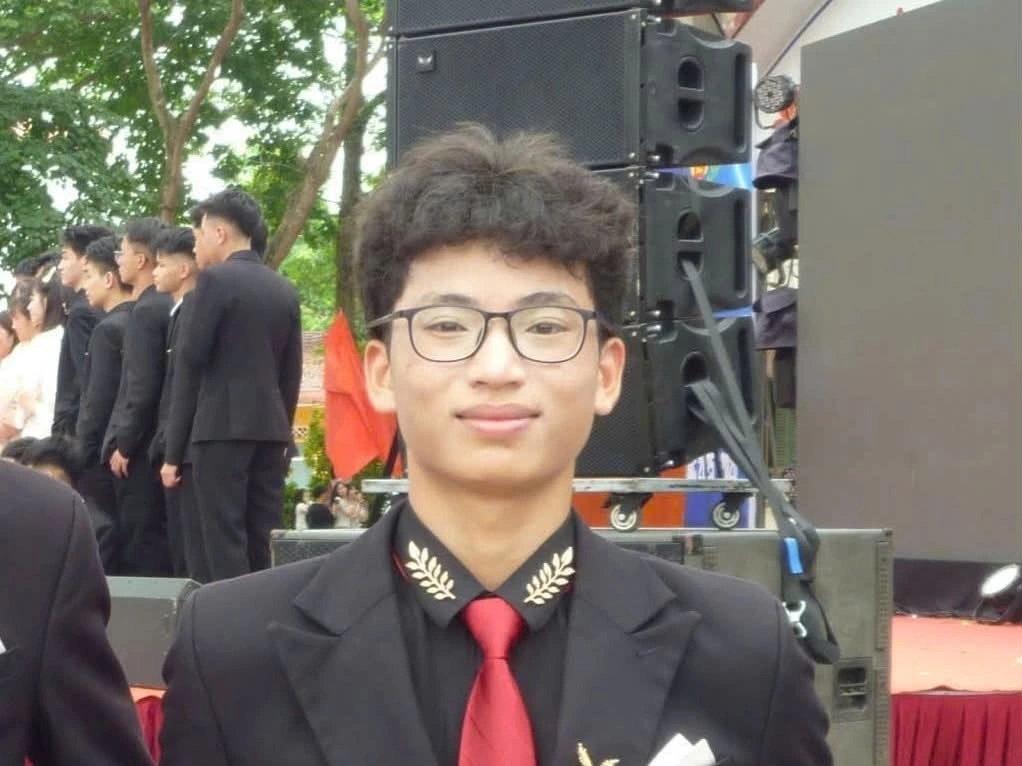
Image of valedictorian of block A00 Nguyen Khac Cong

Image of Nguyen Khac Cong studying hard and doing well

Nguyen Khac Cong's place of study
Top famous Valedictorian
Top famous Zodiac of Capricorn
Top famous Chinese Zodiac of The Pig
Top celebrities born in 2008
Top celebrities born in January
Top celebrities born in 1st
Born in Bac Ninh
Comment:
Cotent:
Events in 2008 and 1-1
Events in the world in the birth year of Nguyen Khac Cong
- Jan. 1–31: Tribal violence erupts in Kenya after December 2007's presidential election between Raila Odinga, of the Orange Democratic Movement, and incumbent president Mwai Kibaki. More than 800 people die in violence across the country. Preliminary results had Odinga defeating Kibaki, 57% to 39%. In the days after the election, however, Odinga's lead dwindled and Kenya's electoral commission declared Kibaki the winner, 46% to 44%. International observers said the vote was rigged.
- Jan. 6: President of Georgia, Mikheil Saakashvili, is reelected, taking 52% of the vote. He had called for early elections in November 2007, after massive protests prompted by accusations that he abused power and stifled dissent.
- Jan. 31: Final report by an Israeli-government-appointed panel, the Winograd Commission, on Israel's 2006 war against the militant group Hezbollah in Lebanon, calls the operation a "large and serious" failure and criticizes the country's leadership for failing to have an exit strategy in place before the invasion.
- Feb. 10: Three men wearing ski masks steal four pieces of artwork from the Zurich Museum in one of the largest art robberies in history. In broad daylight, the robbers took a Cezanne, a Degas, a van Gogh, and a Monet, with a combined worth of $163 million. Feb. 18: Two of the paintings, the Monet and the van Gogh, are found in perfect condition in the backseat of an unlocked car in Zurich.
- Feb. 17: Kosovo's prime minister Hashim Thaci declares independence from Serbia. Serbian prime minister Vojislav Kostunica says he would never recognize the "false state." International reaction is mixed, with the United States, France, Germany, and Britain indicating that they plan to recognize Kosovo as the world's 195th country.
- Feb. 19: Cuban president Fidel Castro, who temporarily handed power to his brother Raúl in July 2006 when he fell ill, permanently steps down after 49 years in power.
- March 2: Dmitri A. Medvedev, a former aide to Russian president Vladimir Putin, wins the presidential election in a landslide. Putin will remain in a position of power, serving as Medvedev's prime minister.
- March 10: Some 400 Buddhist monks participate in a protest march in Lhasa, the capital of Tibet, to commemorate 1959's failed uprising against China's invasion and occupation of Tibet. March 14: Violence breaks out, with ethnic Tibetans clashing with Chinese citizens. Chinese police suppress the demonstrations, and Tibetan leaders say that more than 100 Tibetans are killed.
- April 2: Zimbabwe's Morgan Tsvangirai, of the opposition Movement for Democratic Change, says he won 50.3% of the vote in March 29's presidential election, defeating Robert Mugabe, who has been in power since 1980. April 14: The High Court of Zimbabwe dismisses the opposition's request for the release of election results. The government cracks down on the opposition.
- April 11: In Nepal, millions of voters turn out to elect a 601-seat Constituent Assembly that will write a new constitution. Maoist rebels win 120 out of 240 directly elected seats.
- May 2: More than a month after the presidential election, Zimbabwe officials announce that opposition candidate Morgan Tsvangirai, leader of the Movement for Democratic Change, defeated incumbent Robert Mugabe, 47.9% to 43.2%. A runoff election is necessary because neither candidate won more than 50%.
- May 28: Nepal's newly elected Constituent Assembly votes to dissolve the 239-year-old monarchy and form a republic. King Gyanendra is told he must step down within 15 days.
- June 19: Egypt brokers a cease-fire between Israel and Hamas, the militant group that controls the Gaza Strip. The agreement is intended to stem the violence in the region.
- June 22: Morgan Tsvangirai, of Zimbabwe's Movement for Democracy and Change, who was to face incumbent president Robert Mugabe in a runoff election, withdraws from the race, saying he could not subject his supporters to violence and intimidation. June 27: Mugabe wins the second round of the election, with about 85% of the vote.
- July 2: After being held for nearly six years by Revolutionary Armed Forces of Colombia (FARC) rebels in Colombia, 15 hostages, including three U.S. military contractors and French-Colombian politician Ingrid Betancourt, are freed by commandos who infiltrated FARC's leadership.
- July 14: Luis Moreno-Ocampo, the prosecutor of the International Criminal Court, formally charges Sudan's president, Omar Hassan al-Bashir, with genocide for planning and executing the decimation of Darfur's three main ethnic tribes: the Fur, the Masalit, and the Zaghawa.
- July 21: Radovan Karadzic, the Bosnian Serb president during the war in Bosnia in the 1990s, is arrested outside Belgrade and charged with genocide, persecution, deportation, and other crimes against non-Serb civilians. Karadzic orchestrated the massacre of almost 8,000 Muslim men and boys in 1995 in Srebrenica. July 30: Karadzic is transferred to The Hague to await trial.
- Aug. 7: Fighting breaks out after Georgian soldiers attack South Ossetia, a breakaway enclave in Georgia that won de facto independence in the early 1990s. Separatists in South Ossetia retaliate. Aug. 8: Russia enters the fray, with troops and tanks pouring into South Ossetia to support the region. Aug. 9 and 10: Russia intensifies its involvement, moving troops into Abkhazia, another breakaway region, and launching airstrikes at Tbilisi, the capital of Georgia. Aug. 13: France brokers a deal between Russia and Georgia. President George Bush sends U.S. troops on a humanitarian mission to Georgia. He warns Russia that if it doesn't observe the cease-fire, the country risks its standing in "the diplomatic, political, economic, and security structures of the 21st century." Aug. 29: Russia and Georgia sever diplomatic ties from each other. It is the first time Russia has cut off formal relations with one of its former republics, which gained independence in 1991.
- Aug. 7: Pakistan's governing coalition, led by Asif Ali Zardari, of the Pakistan Peoples Party, and Nawaz Sharif, leader of the Pakistan Muslim League-N, begins impeachment proceedings against President Pervez Musharraf on charges of violating the constitution and misconduct. Aug. 18: Musharraf resigns as president.
- Aug. 15: Nepal's Constituent Assembly elects Maoist leader Pushpa Kamal Dahal, known as Prachanda, as prime minister.
- Aug. 22: As many as 90 Afghan civilians, 60 of them children, die in an airstrike by coalition troops in the western village of Azizabad. It is one of the deadliest airstrikes since the war began in 2001, and the deadliest for civilians. The U.S. military refutes the figures, which were confirmed by the UN.
- Sep. 2: Thai prime minister Samak Sundaravej declares a state of emergency when protests between government supporters and the opposition, People's Alliance for Democracy (PAD), which is calling for Samak's resignation, turn violent. Sep. 9: Samak is forced from office when Thailand's Constitutional Court rules that he violated the constitution by being paid to appear on a cooking show. Somchai Wongsawat, the first deputy prime minister, becomes acting prime minister. Sep. 17: Parliament elects Somchai prime minister.
- Sep. 6: Asif Ali Zardari, leader of the Pakistan Peoples Party and the widower of former Pakistani prime minister Benazir Bhutto, wins 481 out of 702 votes in the two houses of Parliament to become president.
- Sep. 15: In Zimbabwe, President Robert Mugabe and opposition leader Morgan Tsvangirai, who defeated Mugabe 48% to 43% in March 2008 elections but boycotted the June runoff election because of voter intimidation, agree to a power-sharing deal. Tsvangirai will serve as prime minister and the opposition will control 16 ministries. The governing party will control 15; Mugabe will continue as president.
- Sep. 20: A truck bomb explodes outside the Marriott Hotel in Islamabad, Pakistan, killing more than 50 people and wounding hundreds. A previously unknown group, Fedayeen Islam, takes responsibility for the attack.
- Sep. 21: Israeli prime minister Ehud Olmert, who is under investigation for corruption, resigns.
- Sep. 24: Japan's Taro Aso, a conservative and former foreign minister, becomes prime minister, succeeding Yasuo Fukuda, who stepped down amid criticism of his handling of domestic issues.
- Oct. 1: The Iraqi government takes command of 54,000 mainly Sunni fighters from the U.S., which had been paying the fighters for their support. The fighters, members of awakening councils, turned against al-Qaeda in Mesopotamia in 2007 and began siding with the U.S.
- Nov. 16: Iraq's cabinet passes by a large margin a status of forces agreement that will govern the U.S. presence in Iraq through 2011. The pact calls for the withdrawal of all U.S. combat troops by Dec. 31, 2011, and the removal of U.S. troops from Iraqi cities by the summer of 2009. In addition, the agreement gives Iraqi officials increased jurisdiction over serious crimes committed by off-duty Americans who are off base when the crimes occur. Nov. 27: The Iraqi Parliament votes, 149 to 35, to approve the status of forces agreement. Dec. 4: The Presidencial Council, made up of Iraq's president and two vice presidents, gives final approval to the status of forces agreement.
- Nov. 26: More than 170 people are killed and about 300 are wounded in a series of attacks on several landmarks and commercial hubs in Mumbai, India. Indian officials say ten gunmen carried out the attack. It took Indian forces three days to end the siege. Deccan Mujahedeen, a previously unknown group, claims responsibility for the attacks. Pakistan officials deny any involvement in the attacks, but some Indian officials hint that they suspect Pakistani complicity.
- Dec. 2: Thailand's Constitutional Court ruling that the governing People Power engaged in fraud during the 2007 elections forces Prime Minister Somchai Wongsawat from power and bans party members from politics for five years. Dec. 15: Parliament elects Abhisit Vejjajiva, the head of the Democrat Party, as prime minister.
- Dec. 14: At a news conference in Baghdad, a reporter for Al Baghdadia, a Cairo-based satellite television network, hurls his shoes at President Bush and calls him a "dog." The shoes narrowly miss Bush's head.
- Dec. 22: Guinea's despotic president, Lansana Conte, dies after 24 years in power. Dec. 24: Junior army leaders launch a coup. Army captain Moussa Camara takes over as president of the republic.
- Dec. 28: Days after a cease-fire between Israel and Hamas expired, Hamas begins launching rocket attacks into Israel, which retaliates with airstrikes that kill about 300 people. Israel targets Hamas bases, training camps, and missile storage facilities.
Birthday Nguyen Khac Cong (1-1) in history
- Day 1-1 year 1863: Abraham Lincoln issued the Emancipation Proclamation.
- Day 1-1 year 1908: The ball signifying the New Year was dropped for the first time at Times Square in New York City.
- Day 1-1 year 1914: The world's first airline, St. Petersburg Tampa Airboat Line, starts operation in St. Petersburg, Florida.
- Day 1-1 year 1959: Fidel Castro and his revolutionaries took over Cuba and toppled Fulgencio Batista's regime.
- Day 1-1 year 1975: John Mitchell, H. R. Haldeman, and John Ehrlichman were convicted of obstruction of justice in the Watergate affair.
- Day 1-1 year 1993: Czechoslovakia peacefully split into the Czech Republic and Slovakia.
- Day 1-1 year 1994: The North American Free Trade Agreement (NAFTA) went into effect.
- Day 1-1 year 2002: Euro coins and notes went into circulation in twelve European nations.